In the spring of 1886, thousands of workers across the U.S. moved over 11,000 miles of railroad tracks 3 inches closer to the other in less than 48 hours.
Why? Because of different rail gauges (width), trains from the North and South could not physically cross the junctions where these tracks met, and at some point (it only took 60 or so years), it made more sense to just move the tracks rather than unload and then reload their cargoes at these junction points.
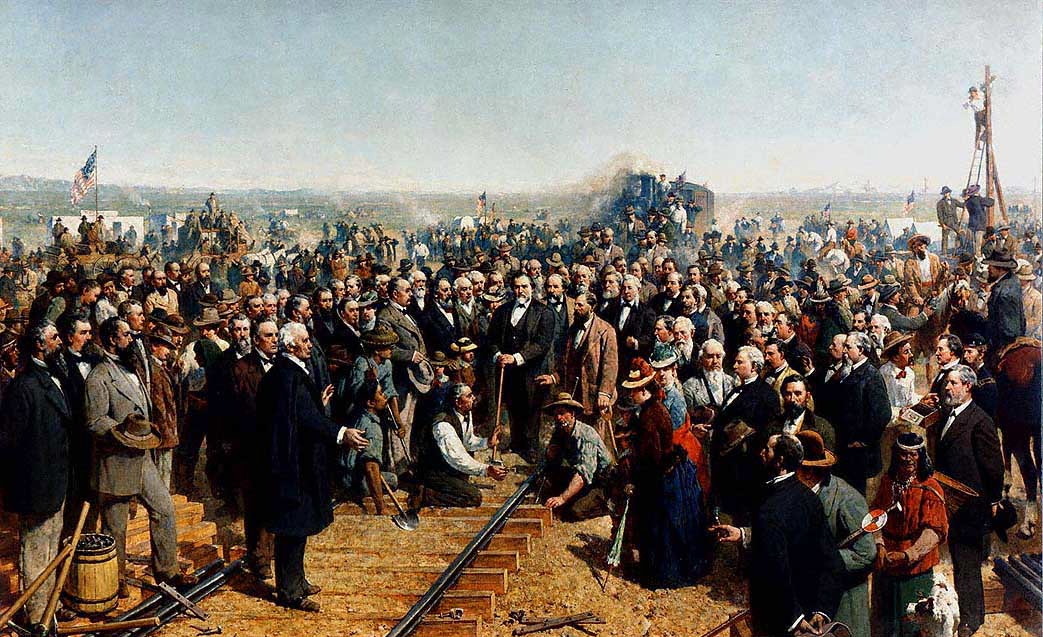
(Image: The Last Spike, Thomas Hill)
The AI track (pun intended)
AI moves a lot quicker than that - tracks have been laid at differing widths over the last 18 months and are now converging under the same roof. The track in this scenario carries AI agents.
- AI agents, which are software that carry out specific jobs, need to speak to your different systems, which they do via the Model Context Protocol (MCP) introduced by Anthropic and donated to the Agentic AI Foundation (AAIF) in 2025, a foundation built specifically for agent standards.
- They also need to be able to hand off the work to another agent (e.g. your scheduling agent has to speak to your chief-of-staff agent), which uses the A2A (Agent to Agent) protocol (the first draft came from Google which it launched with several partner companies). Google donated A2A to the Linux Foundation in 2025.
This month, A2A moved under the AAIF. You can read the details here but this is the bottom line as to why it matters to companies building agents:
The Linux Foundation model for open standards has a track record. When foundational components are owned by a single vendor, every downstream team absorbs that vendor's roadmap constraints and release cycles. When they're governed openly, the community shapes what gets built and when.
A2A's 150+ partner organizations include direct competitors. That breadth only holds together under governance that no single participant controls. The Agentic AI Foundation, hosted by the Linux Foundation, provides that structure. It also means the full stack, from context to communication to operations to the open agent layer, is governed in the same way and in the same place.
For teams building multi-agent systems, this removes a specific category of risk. The protocol your agents depend on for cross-framework communication isn't subject to a single vendor's product decisions.
Thanks for the history lesson, but who cares
If you've been building agents or holding back on building them because you weren't sure how these protocols would work together or be governed, that uncertainty is now gone. The rails have been connected on the same gauge and your agents can connect to others that are built on the same rails, opening up multiple ecosystems for you to sell in. Which begs the question, which ecosystems (routes/depots if we're continuing with the railroad analogy) do you need to show up in?
If you're buying agents, ask your vendors if they're speaking MCP and A2A. If they speak the same standard then you can switch vendors or integrate with agents built by other companies easily. If not, you risk getting trapped.
This edition of Bits & Bytes covers the AI ecosystem for CEOs, operators, and practice leaders. Partner1® is the premier partner activation firm built by former Microsoft executives. We help B2B companies grow profitably and globally through partner ecosystem-led growth.
Curious about what partner ecosystem-led growth can do for your company? Here are a short Marketplace Assessment and a longer partner ecosystem assessment that gets you started.
If someone forwarded this to you, you can subscribe here and follow us at www.partner1.io.